Portland buys countertops the way it buys everything — deliberately, with taste, and with an eye on the finish. SlabOS is the all-in-one platform that helps PNW shops sell design-driven remodels with live 2D→3D quoting, hold margin on premium stone with automatic slab nesting, and run the whole shop on one login.
▶ The platform tour — playing now · tap for sound
Portland isn't a tract-home gold rush — it's a city of older housing stock that gets renovated, well. Bungalows in Alberta and Sellwood, mid-century ranches in Beaverton and Lake Oswego, infill and ADUs across the east side, hillside builds up in the West Hills. Most of the work is remodel and replacement, and the homeowner has usually been on Pinterest for months before they call you.
That buyer doesn't want a spreadsheet of allowances — they want to see the kitchen. And with no sales tax in Oregon, the quoted number is the number they compare. Whoever hands them a clean, three-dimensional visual with an accurate price tends to walk away with the job.
Draw the job in 2D. The homeowner sees it in live 3D.
Older homes in Irvington, Laurelhurst, Multnomah Village and Hillsdale mean odd layouts, custom templates, and clients who care how it turns out.
Portland homeowners arrive with a mood board. A flat line drawing under-sells the work — they want to picture the finished island.
Dramatic quartzite, marble and waterfall edges are PNW favorites — and that's exactly where slab layout and vein matching decide the margin.
In Oregon there's no tax line to soften the comparison. Your estimate is read against the next shop's at face value, so it has to be sharp and right.
A template in Vancouver, WA, a slab pickup in NW industrial, an install in Tigard — crews cross the Willamette, the Columbia and a tax border in one day.
Wet-season templating and installs leave little slack — a missed dispatch or a re-measure can cost a whole rainy day on the calendar.
Neighborhoods and suburbs are named only to describe the Portland metro market in general. SlabOS makes no claim about, and does not reference, any specific local fabrication business.
Draw the countertop in 2D and watch it render in real-time 3D as you go. Pricing updates live off your own Portland price lists — edges, waterfalls, cutouts, thickness, splash — so the number is right the moment the design is.
A Lake Oswego homeowner or an east-side designer sees the finished island, not a flat sketch — and gets a number that holds. For a buyer who's been collecting inspiration for months, seeing their kitchen rendered in front of them is what turns a maybe into a deposit.
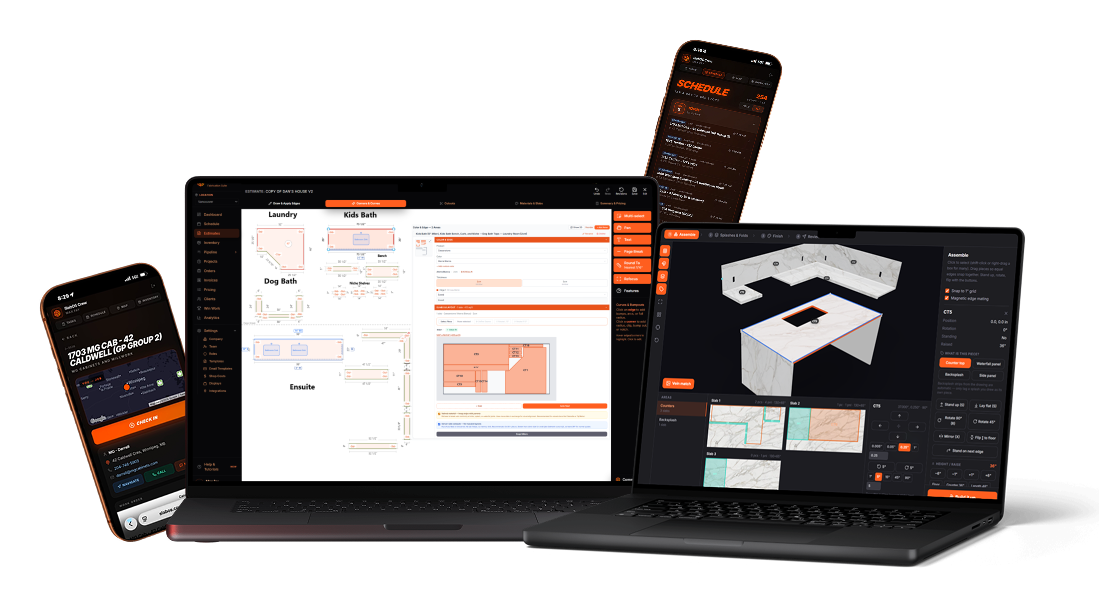
One login for the estimating desk, the 3D studio, the schedule, and the crew in the field.
When the job is exotic quartzite or book-matched marble — the stuff Portland kitchens are built on — every slab is expensive and every inch counts. SlabOS nests your pieces automatically — one click runs roughly 30,000 placement operations to find a best-fit layout that gets more out of every slab.
Moraware's stack has nesting too — but it's done by hand. Manual layout means padding "to be safe," and on a $90/sqft slab that wasted yield is real money off the top. Automatic nesting lets you quote premium material confidently without quietly eating the cost of the offcut.
One click tests tens of thousands of placements per slab.
A $12M/yr production shop used SlabOS nesting to underbid a $1M+ job — and held their margin doing it. The same automatic-yield advantage applies to every Portland bid, from a single quartzite island in Sellwood to a full multi-unit east-side project.
SlabOS clearly understands how to strike the right balance between fabrication and software. My only gripe: I didn't discover it sooner.
UI, integrations, performance, pricing ROI, sales features, support, onboarding, AI, the quoting engine, KPIs. Nothing to dislike — it's everything we've ever wanted.
CounterGo to quote, Systemize for jobs and the calendar, a separate Inventory product for slabs — re-keyed by hand.
Manual layout means padding for safety — yield you give away on every premium-stone Portland job.
Design-led homeowners want to picture the finished kitchen — a flat drawing doesn't sell the look.
DIY exports and spreadsheets to move your own history — so shops stay stuck.
If your Portland shop is on the Moraware stack — CounterGo, Systemize, and a separate Inventory product stitched together — SlabOS replaces all three with one platform, one login, one bill.
And the switch is done for you. We migrate accounts, contacts, quotes (with the actual drawings), jobs, activity history, calendar, and slab inventory. A $12M/yr production shop moved 20,000+ jobs and 18,000+ quotes in about four hours — quoting in SlabOS the same day. A Pacific Northwest shop's switch looks the same: no data left behind, searchable from day one.
“All of it came over in an afternoon — 18,000+ quotes and our full job history migrated in about 4 hours. Nothing was lost. We were quoting in SlabOS the same day.”
Book a demo and we'll draw one of your actual jobs in 3D, nest it onto a slab, quote it live off your price list, and show you the whole shop running on one screen.
One platform · one flat fee · unlimited seats · see pricing
Yes. Portland is a remodel-led, design-conscious market — older housing across the east side and west hills, premium materials like quartzite and marble, and homeowners who research the finish before they ever call. SlabOS is built for that: fast 2D→3D quoting that sells the look and lands the deposit, automatic slab nesting to protect margin on expensive stone, plus scheduling, a mobile crew app, slab inventory, a customer portal, and built-in AI — all on one login. It fits a two-person shop and scales to a multi-crew operation working both sides of the Columbia.
Yes. Moraware is three products — CounterGo for quoting, Systemize for jobs and the calendar, and a separate Inventory product for slabs — that you stitch together by hand. SlabOS replaces all three with one platform: quoting, live 3D, scheduling, the crew app, slab inventory, the customer portal, and AI under a single login and one flat bill. The biggest practical difference is nesting — Moraware nests slabs manually, SlabOS does it automatically — which is where Portland shops protect the margin on premium stone. See the full SlabOS vs Moraware breakdown.
It's done for you. We migrate your accounts, contacts, quotes (with the actual drawings), jobs, activity history, calendar, and slab inventory — your shop doesn't have to wrangle exports and spreadsheets. As a reference point, one $12M/yr production shop moved 20,000+ jobs and 18,000+ quotes across in about four hours and were quoting in SlabOS the same day. A Portland shop's switch follows the same path: nothing left behind, everything searchable from day one.
When the slab is exotic quartzite or book-matched marble, every offcut is expensive. SlabOS nests your pieces automatically — one click runs roughly 30,000 placement operations to find a best-fit layout that gets more out of every slab. That recovered yield is real margin: it lets you quote premium material confidently instead of padding the slab count by hand "to be safe" and quietly eating the waste. On the dramatic, high-cost stone Portland kitchens favor, the difference is even bigger. See how nesting works.
Yes. A typical day might mean a template in Vancouver, WA, a slab pickup in NW industrial Portland, and an install out in Tigard or Lake Oswego. SlabOS keeps scheduling, the mobile crew app, slab inventory, and the customer portal in one system, so dispatches, measurements and photos stay connected across the rivers and the state line — no re-keying between three separate tools and a spreadsheet.
Pricing is custom to your shop — one flat platform fee for the whole system (drawing, quoting, scheduling, inventory, crew app, portal, and AI) with unlimited seats, instead of paying per-product and per-seat across three separate tools. See the pricing page, or book a demo and we'll set the right plan for a Portland operation your size.