Toronto is the largest, busiest countertop market in Canada — and one of the toughest to run a shop in. SlabOS is the all-in-one platform that helps GTA fabricators turn condo and 905-belt volume into won jobs with faster 2D→3D quoting, hold margin with automatic slab nesting, and run the whole operation on one login — priced in Canadian dollars.
▶ The platform tour — playing now · tap for sound
The GTA is really two countertop markets stacked on top of each other. Downtown and along the subway lines it's condo work — tower after tower in CityPlace, Liberty Village, Yonge & Eglinton, North York Centre and the waterfront, where developers buy kitchens by the floor and a single delayed quote can hold up a whole closing schedule. Out in the 905 it's suburban sprawl — Vaughan, Markham, Brampton, Mississauga, Oakville, Pickering, Whitby — endless new subdivisions and big-ticket renovations.
Both halves are crowded with shops, and both reward the same thing: a clean, visual quote in the client's hands first, priced right the first time. In a market this dense, slow flat estimates lose to fast three-dimensional ones — every single time.
Draw the job in 2D. The client sees it in live 3D.
Highrise projects downtown and in North York mean repeating unit kitchens by the hundred — developers want one accurate package, not estimates re-keyed unit by unit.
Builders in Vaughan, Brampton, Markham and Milton want template-to-install turnarounds that hold their closing dates across the whole subdivision.
Forest Hill, Rosedale, Oakville and Mississauga homeowners want to see the finished kitchen in 3D before they sign — not squint at a flat line drawing.
Snow, salt and short days compress the install calendar from December to March. Crews, templates and deliveries have to be sequenced tightly when weather can move a date.
With so many shops bidding the same condo packages and subdivisions, padding the slab count "to be safe" is margin handed straight to the next bidder.
A template in Pickering, an install in Oakville, a slab pickup off the 400 — GTA traffic means crews and calendars have to be planned around the corridor, not just the clock.
Neighbourhoods and suburbs are named only to describe the Greater Toronto Area market in general. SlabOS makes no claim about, and does not reference, any specific local fabrication business.
Draw the countertop in 2D and watch it render in real-time 3D as you go. Pricing updates live off your own GTA price lists, in Canadian dollars — edges, cutouts, thickness, splash — so the number is right the moment the design is.
A homeowner renovating in Etobicoke or a developer reviewing a Liberty Village condo package sees the finished kitchen, not a flat sketch — and gets a number on the spot. When three shops are chasing the same job in a market this dense, being the fast, professional, three-dimensional one is how you take it.
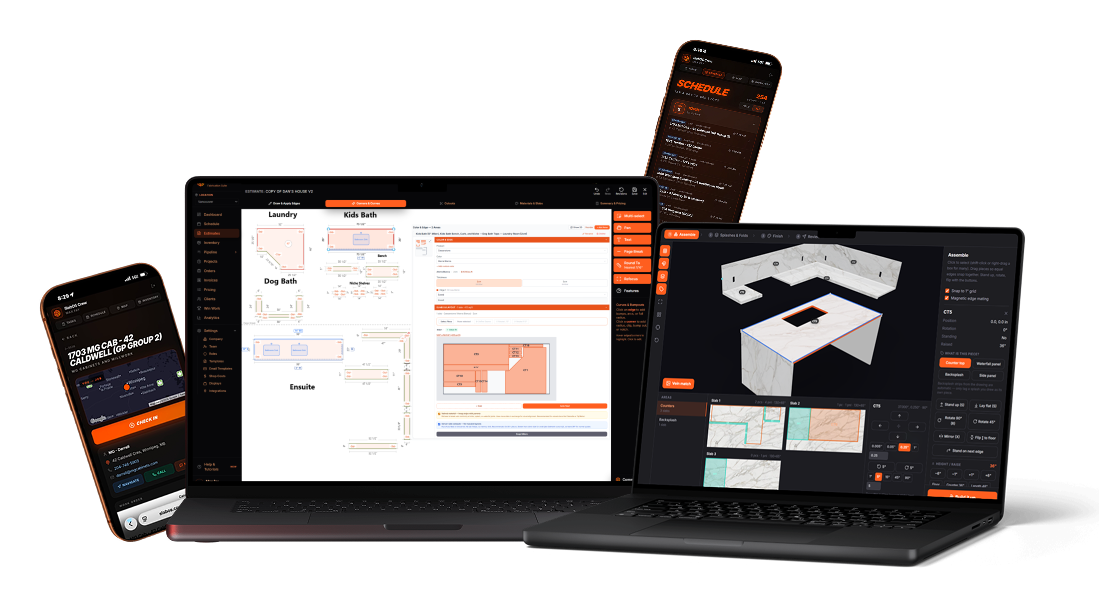
One login for the estimating desk, the 3D studio, the schedule, and the crew in the field.
On a Toronto condo package, a single wasted slab gets multiplied across every unit — and on a high-end reno, one extra slab can be the whole profit. SlabOS nests your pieces automatically — one click runs roughly 30,000 placement operations to find a best-fit layout that gets more out of every slab you buy in CAD.
Moraware's stack has nesting too — but it's done by hand. Manual layout means padding "to be safe," and on a 200-unit tower or a book-matched quartzite kitchen that yield you give away is exactly the margin you needed to win. Automatic nesting lets you bid sharper without bleeding profit.
One click tests tens of thousands of placements per slab.
A $12M/yr Canadian production shop used SlabOS nesting to underbid a $1M+ job and held their margin doing it. The same automatic-yield advantage applies to every GTA bid, from a single Forest Hill kitchen to a full condo tower package.
SlabOS clearly understands how to strike the right balance between fabrication and software. My only gripe: I didn't discover it sooner.
UI, integrations, performance, pricing ROI, sales features, support, onboarding, AI, the quoting engine, KPIs. Nothing to dislike — it's everything we've ever wanted.
CounterGo to quote, Systemize for jobs and the calendar, a separate Inventory product for slabs — re-keyed by hand.
Manual layout means padding for safety — yield you give away on every condo package and reno bid.
GTA buyers want to picture the finished job — a flat drawing doesn't sell the way 3D does.
DIY exports and spreadsheets to move your own history — so shops stay stuck.
If your GTA shop is on the Moraware stack — CounterGo, Systemize, and a separate Inventory product stitched together — SlabOS replaces all three with one platform, one login, one bill, billed in Canadian dollars.
And the switch is done for you. We migrate accounts, contacts, quotes (with the actual drawings), jobs, activity history, calendar, and slab inventory. A $12M/yr Canadian fabricator on the same legacy stack moved 20,000+ jobs and 18,000+ quotes in about four hours, quoting in SlabOS the same day. A Toronto shop's switch looks the same: no data left behind, searchable from day one.
“All of it came over in an afternoon — 18,000+ quotes and our full job history migrated in about 4 hours. Nothing was lost. We were quoting in SlabOS the same day.”
Book a demo and we'll draw one of your actual jobs in 3D, nest it onto a slab, quote it live off your price list in CAD, and show you the whole shop running on one screen.
One platform · one flat fee · unlimited seats · see pricing
Yes. Toronto is the largest and busiest countertop market in Canada — high-volume condo production downtown, vast new-build subdivisions across the 905 belt, and a steady stream of high-end renovations. SlabOS is built for exactly that pressure: fast 2D→3D quoting to win bids, automatic slab nesting to hold margin on granite, quartz and porcelain, plus scheduling, a mobile crew app, slab inventory, a customer portal, and built-in AI — all on one login, priced in Canadian dollars. It works for a two-person shop and scales to a multi-crew operation running across the whole GTA.
Yes. Moraware is three products — CounterGo for quoting, Systemize for jobs and the calendar, and a separate Inventory product for slabs — that you stitch together by hand. SlabOS replaces all three with one platform: quoting, live 3D, scheduling, the crew app, slab inventory, the customer portal, and AI under a single login and one flat bill in CAD. The biggest practical difference is nesting — Moraware nests slabs manually, SlabOS does it automatically — which is where GTA shops recover the margin they need to bid competitively on condo packages and reno work. See the full SlabOS vs Moraware breakdown.
It's done for you. We migrate your accounts, contacts, quotes (with the actual drawings), jobs, activity history, calendar, and slab inventory — your shop doesn't have to wrangle exports and spreadsheets. As a reference point, A $12M/yr Canadian production shop moved 20,000+ jobs and 18,000+ quotes across in about four hours and were quoting in SlabOS the same day. A Toronto shop's switch follows the same path: nothing left behind, everything searchable from day one.
In a market this competitive, the difference between winning and losing is often a single slab — and on a condo package that one slab gets multiplied across every unit. SlabOS nests your pieces automatically — one click runs roughly 30,000 placement operations to find a best-fit layout that gets more out of every slab you buy in CAD. That recovered yield is real margin: it lets you bid sharper without cutting into profit, instead of padding the slab count by hand "to be safe." On book-matched quartzite and marble — popular in high-end Toronto renos — the difference is even bigger. See how nesting works.
Yes. The same platform handles a single luxury reno in Rosedale and a multi-tower condo package downtown. Quoting, live 3D, scheduling, slab inventory, the crew app, and the customer portal all live in one system, so larger jobs with hundreds of repeating units and multiple crews stay coordinated across the GTA's wide footprint — and through a compressed winter install calendar — instead of fragmenting across three products and a spreadsheet.
Pricing is custom to your shop — one flat platform fee for the whole system (drawing, quoting, scheduling, inventory, crew app, portal, and AI) with unlimited seats, instead of paying per-product and per-seat across three separate tools. See the pricing page, or book a demo and we'll set the right plan for a GTA operation your size.