One platform to draw, quote, nest slabs, schedule crews, and run every job — built for the pace of a high-growth Sun Belt metro where remodels and new-build subdivisions never stop. And we move you off Moraware for you.
▶ The platform tour — playing now · tap for sound
Phoenix is one of the largest, fastest-growing metros in the country — and one of the most competitive markets in the U.S. for countertop work. Two distinct streams keep Valley shops busy at once: production countertops for new-build subdivisions sprawling across the West Valley and the Southeast Valley, and a steady remodel pipeline driven by relocations and homeowners refreshing 1990s and 2000s builds.
It's a market with its own rhythm. A near-year-round build season means there's no slow quarter to catch up in — quotes can't sit. Production builders want turnaround measured in days and pricing that holds across a whole community of plans. And the geography is wide: a single crew route can run from Surprise and Buckeye out to Gilbert, Chandler, Mesa, and Scottsdale, so dispatch and field updates have to actually work on a phone in a truck.
Fig. 01 — Draw it in 2D. Watch it render in live 3D for the homeowner.
From the West Valley to the East Valley to North Scottsdale, one crew can cover a lot of ground in a day. SlabOS keeps schedule, job status, and field photos on every installer's phone so nobody drives a route on stale info.
Valley fabricators often run production builder accounts and walk-in remodel work side by side. SlabOS holds separate price lists per account and quotes both off your real numbers — no second tool, no re-keying.
When the build calendar barely slows, the software can't be the bottleneck. Draw, quote, nest, and dispatch in one pass so the pipeline keeps moving as fast as the Valley does.
Quote in CounterGo, run jobs and the calendar in Systemize, track slabs in a separate Inventory product — re-keyed by hand between them.
Manual nesting with padding "to be safe" — yield you give away on every competitive Phoenix bid.
On a wide Valley route, a crew working off a printout or a stale screen costs a whole drive.
DIY exports and spreadsheets to move your own years of history.
The legacy way splits a fabrication shop across three products — one to quote (CounterGo), one to run jobs and the calendar (Systemize), and a separate Inventory product for slabs — and leaves you to stitch them together by hand. In a market that builds all year, every hand-off is a place a Phoenix quote stalls. You found tools. Not the workshop.
SlabOS runs the entire job from first measure to final install on one platform — so a Phoenix estimator, the slab yard, and the install crew are all looking at the same job, live.
Fig. 03 — Draw live in 2D, quote it in real time off your own price lists.
Fast 2D drawing with a real-time 3D engine. Show the homeowner the finished kitchen, not a flat sketch.
Priced as you draw, off your own price lists — edges, cutouts, thickness, per-account builder rates.
Nests pieces to fit more per slab. More yield, more margin on every competitive Valley bid.
Jobs, crew scheduling, and a calendar in the same system as your quotes — built for wide Valley routes.
A mobile crew app for onsite work across the metro, plus a customer portal for approvals.
Track inventory to the piece, in the same system that quotes and nests the work.
Ask your own data in plain English, import price lists, and sync the books.
Accounts, quotes, jobs, history, and inventory moved across — drawings included.
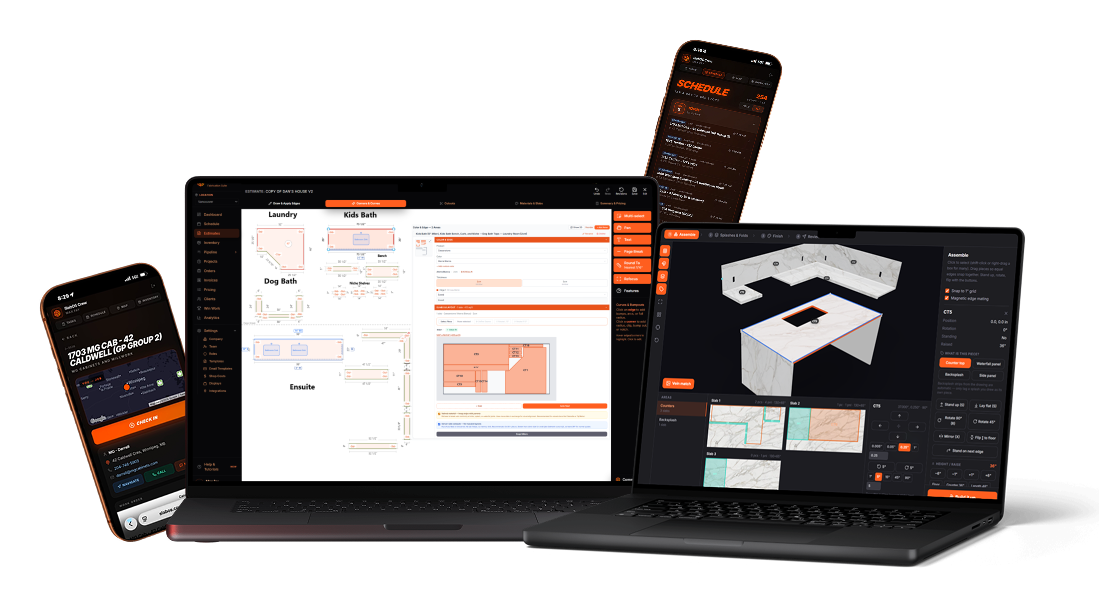
Fig. 03b — One login. Estimating desk, 3D studio, schedule, and the crew in the field.
In a market this competitive, the bid often comes down to how many pieces you can pull from a slab. SlabOS nesting is automatic — one click tests tens of thousands of placements (roughly 30,000 best-fit operations) to pack more per slab than a hand layout ever would.
That's not theory. A $12M/yr production shop used SlabOS nesting yield to underbid a $1M+ job — and kept their margin while doing it. Moraware's inventory product has nesting too; the difference is theirs is manual and ours is automatic. On a Phoenix bid sheet, that gap is the win.
SlabOS clearly understands how to strike the right balance between fabrication and software. My only gripe: I didn't discover it sooner.
UI, integrations, performance, pricing ROI, sales features, support, onboarding, AI, the quoting engine, KPIs. Nothing to dislike — it's everything we've ever wanted.
The reason most Phoenix shops stay on a stack they've outgrown is the dread of moving years of history. So we do it for you — accounts, contacts, quotes (with the actual drawings), jobs, activity, calendar, and slab inventory. 20,000+ jobs and 18,000+ quotes have already come across.
“All of it came over in an afternoon — 18,000+ quotes and our full job history migrated in about 4 hours. Nothing was lost. We were quoting in SlabOS the same day.”
Fig. 05 — A real migration, in the owner's words.
Book a demo — we'll draw one of your real Phoenix jobs in 3D, auto-nest it onto a slab, quote it off your own price list, and show you the whole shop working on one screen.
One platform · unlimited seats · pricing is custom — book a demo
Yes. Phoenix is a large, competitive Sun Belt metro with both steady new-build production work and a strong remodel pipeline, and a near-year-round build season. SlabOS runs the whole shop on one platform — drawing, live pricing, automatic slab nesting, scheduling, slab inventory, a mobile crew app, a customer portal, and built-in AI — so quotes don't stall and crews running wide Valley routes always work off the live job.
That's a common Valley setup, and yes. SlabOS holds separate price lists per account, so production builder rates and walk-in remodel pricing live side by side and quote off your real numbers — no second tool and no re-keying between them.
SlabOS nesting is automatic. One click runs roughly 30,000 best-fit placement operations to pack more pieces per slab than a hand layout would. Moraware's inventory product has nesting as well — the difference is that theirs is manual and ours is automatic. In a competitive market like Phoenix, the extra yield often decides the bid: one shop used SlabOS nesting to underbid a $1M+ job while protecting margin.
Yes — it's done for you. SlabOS migrates accounts, contacts, quotes (with the actual drawings), jobs, activity history, the calendar, and slab inventory. One shop moved 20,000+ jobs and 18,000+ quotes across in about four hours, searchable from day one. You're not exporting spreadsheets yourself.
Yes. The mobile crew app puts the schedule, job status, and field photos on every installer's phone, so a route running from the West Valley out to Gilbert, Chandler, Mesa, or Scottsdale stays on the live job — not a printout or a stale screen. Office, yard, and field all see the same thing.
Pricing is custom to your shop — one platform with unlimited seats instead of three separate products to license and stitch together. Book a demo and we'll set the right plan for your Phoenix operation. See the pricing page for details.