We asked shop owners what finally made them look. Not one of them said “better interface.” They said their software made them click more and swear more, type the same job into three programs, and drive to the shop on a Friday to find out what was being cut. Five reasons, in their words.
Quotes are used with permission and shortened for length. Names are reduced to a first name and initial at the speakers’ discretion — several are still running the software they’re describing.
“My click count and my swear-word count have gone up by orders of magnitude.”
“It was a complete circus. My team was doing triple the work.”
“We’re paying thousands a month to be their unpaid guinea pigs.”
“I had to drive to the shop floor just to see what we were cutting.”
“You don’t own a business. You own a ticking time bomb.”
Five owners. Five reasons. Every one of them answered below.
Nobody quits software because the icons are ugly. They quit because a job that should take three minutes takes thirty, every day, forever.
A seven-year industry veteran built the same L-shape kitchen quote on both systems. Thirty-one minutes on the old one. Under three on SlabOS. Same shop, same kitchen, same person.
Click, drag, done. The engine handles the corners, the miters and the seams while you draw.
Every edge, cutout and seam prices off your own list in real time. No second pass in a spreadsheet.
The six-step wizard exists so nobody has to remember what order to do things in.
One click. The drawing, material, pricing and customer carry across intact.
Templating, fab and install scheduled from the job, with the crew assigned.
The same record from first call to payment. Nothing is entered twice.
Every handoff between programs is a re-type, and every re-type is a wrong number, a missed cutout, a remake you eat on a Friday. You don't see it on an invoice. You see it in rework.
In SlabOS the quote becomes the job. The job hits the calendar, lands on the crew's phones, and invoices itself. The customer is typed once, by whoever took the call.
This is the fair one, and the only honest answer to it is evidence rather than a promise.
Our roadmap is public and dated. What's in beta is labelled beta, you don't pay extra for it, and you don't have to use it. Everything else has been running real shops for years.
The public roadmap lists what shipped and when. Check the dates yourself.
Blueprint takeoff carries a beta tag on every page it appears on. No surprises at renewal.
Custom feature requests are included on every plan. Shops ask, we build.
Built-in AI answers from your real jobs, quotes, revenue and leads.
Crew check-ins, slab photos and job status come off the truck as work happens.
Pipeline, margin and revenue update as the shop works, wherever you're sitting.
If the only way to know what's happening is to stand in the building, you don't own a business — you are a component of it.
Ask SlabOS what you sold last month, who's sitting on stale quotes, or which material actually makes money. Plain English, off your own numbers. No exports, no spreadsheets, no drive.
This is the one that keeps owners up, and it's the one no feature comparison ever covers.
In SlabOS the pricing rules, the edge and thickness math, the markup and the nesting logic live in the system, not in a head. Every estimator quotes the same way and nests the same way — the yield edge stops swinging with whoever's drawing.
Material, edge, thickness, cutout and seam pricing configured once, applied by everyone.
The same engine runs on every quote, whoever hit the button.
Calls land on the job with transcripts, so the history survives the handover too.
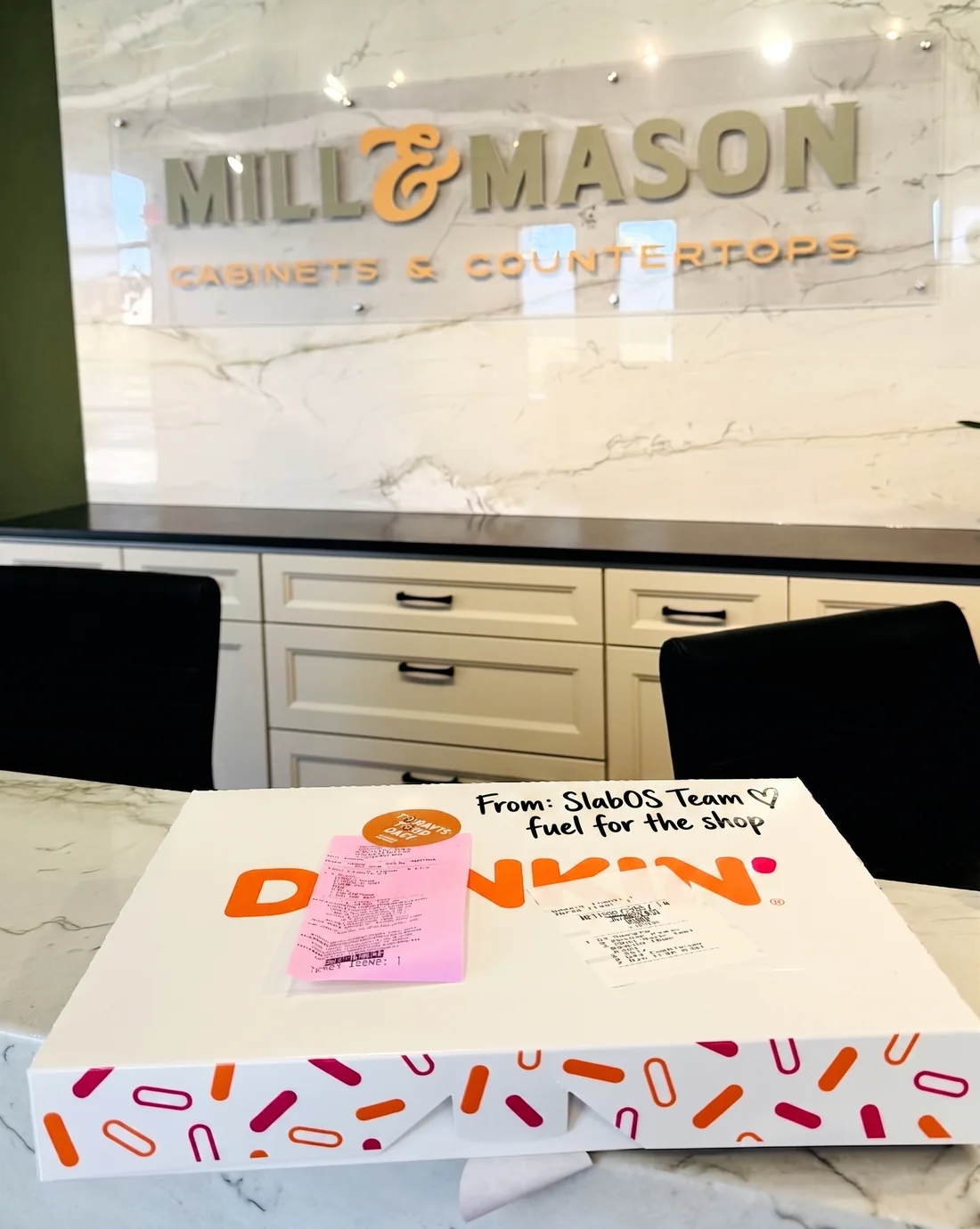
Not a feature. Not in the contract. It just seemed like the thing to do.
Published with Mill & Mason’s blessing.
Book a demo and bring the job you'd least like to quote — the plan set, the awkward island, the price list nobody but one person understands. We'll build it in front of you and you can decide whether any of the five above sound like your shop.
Yes. Every quote is from a real countertop shop owner and is used with their permission, shortened for length but not reworded. Names are reduced to a first name and initial deliberately — several of them are still paying for the software they're describing, and we're not going to make that awkward for them.
Because the people who said these things have vendors, customers and reputations of their own, and a searchable page naming them is a bigger ask than a private conversation. If a shop wants to be named, we're happy to — the ones on our customer stories page are.
Some of them, sort of. You can hire a second estimator to cut quoting time, or discipline your way through triple data entry. What you can't fix by trying harder is a system that keeps the knowledge in one person's head, or three programs that were never designed to talk.
It usually still rhymes with one of them. Bring it to the demo — we'd rather hear a sixth reason than pretend the list is complete.